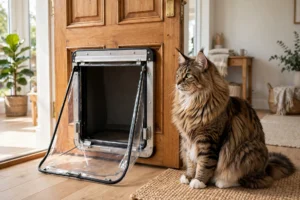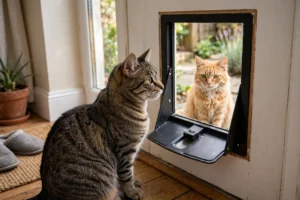
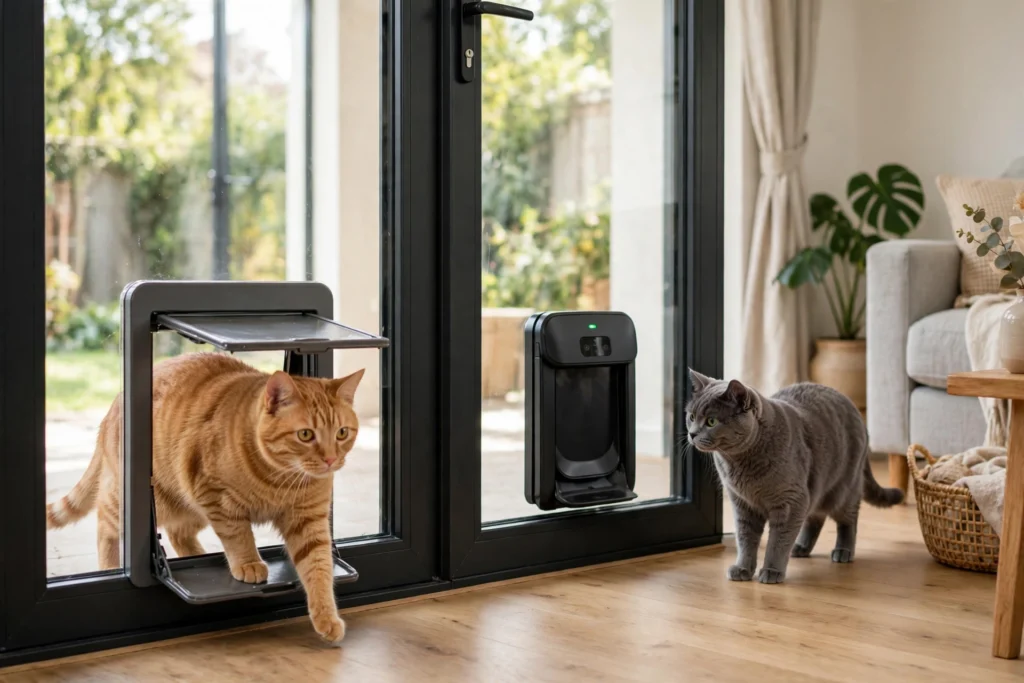
Both flaps give your cat freedom to come and go. The difference is who else gets to use the door. That single difference decides most purchases.
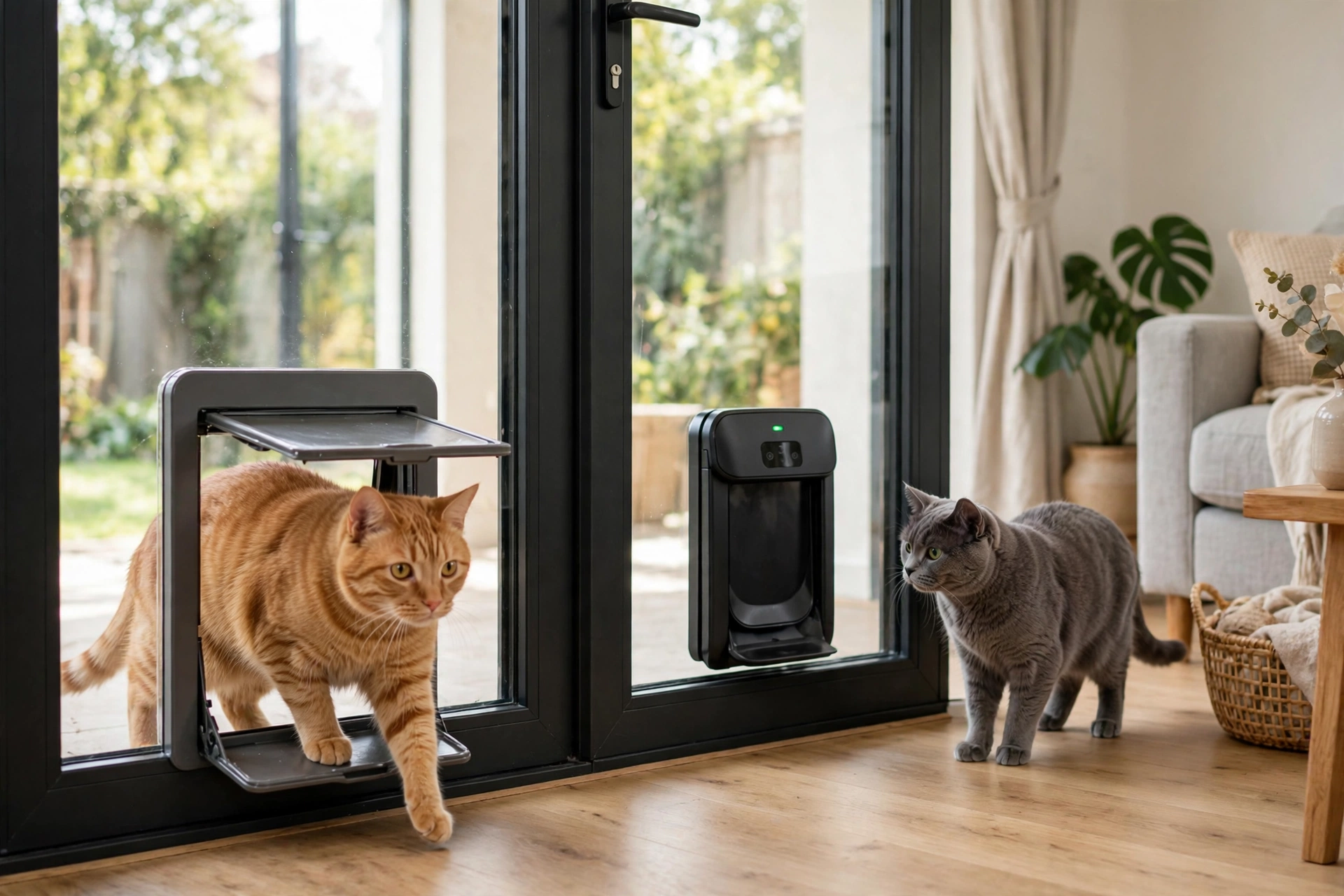
How a manual flap works
A manual flap is a swinging panel in a frame. Your cat pushes it with its head, walks through, and it falls shut behind. There is no electronics, no batteries, and nothing to program.
Most manual flaps have a simple sliding lock you move by hand. At night you can set it to in-only, out-only, or fully locked. It is honest, mechanical, and it works for years with no attention.
The trade-off is total: anything that can push the flap can enter. Your cat, the neighbour’s cat, a stray, a curious kitten. The flap cannot tell them apart.
How a microchip flap is different
A microchip flap adds a reader and a lock to the same swinging panel. It reads the implanted chip of each approaching animal and releases the lock only for registered numbers. Everything else meets a locked door.
For your own cats, daily life feels identical to a manual flap. They push, it opens, they pass. The technology is invisible to the animal it serves.
The cost of the cleverness is small: four AA batteries and a minute of programming per cat. There is no wiring and no subscription.
The stray question
In much of the UAE, community cats roam freely. A manual flap in a villa near a feeding spot will get visitors. Some owners do not mind. Many do, especially when a tom sprays the hallway or eats the resident cat’s food.
This is the question to answer honestly: do uninvited animals reach your door? If yes, the manual flap’s simplicity becomes a liability. If your door opens onto a high balcony or a sealed courtyard, the manual flap’s simplicity is pure advantage.

When a manual flap is enough
Apartments above the ground floor, villas with enclosed courtyards, and homes in streets with no roaming cats are all fine with manual. Your cat is the only animal that can reach the door, so a lock that checks identities adds nothing.
Manual also suits owners who want the simplest possible object in their glass. No batteries to change, no programming, nothing to explain to a pet sitter.
When the microchip earns its place
Ground-floor villas, homes near restaurants or bins, and anywhere feeders maintain street cats: fit the microchip. The first time a stray walks in at 3 a.m., the extra cost feels like the bargain of the year.
Timid cats benefit too. A nervous cat that has been ambushed at the flap by a bolder stray may stop going out entirely. A door that only opens for family removes the ambush.
The pet sitter test
Imagine explaining the door to a pet sitter. With a manual flap, you show the slider lock and the night routine. With a microchip flap, there is nothing to explain. The cats come and go, the strays stay out, and the sitter never touches the door.
Homes that use sitters regularly tend to favour the microchip for this reason alone. Fewer instructions means fewer mistakes.
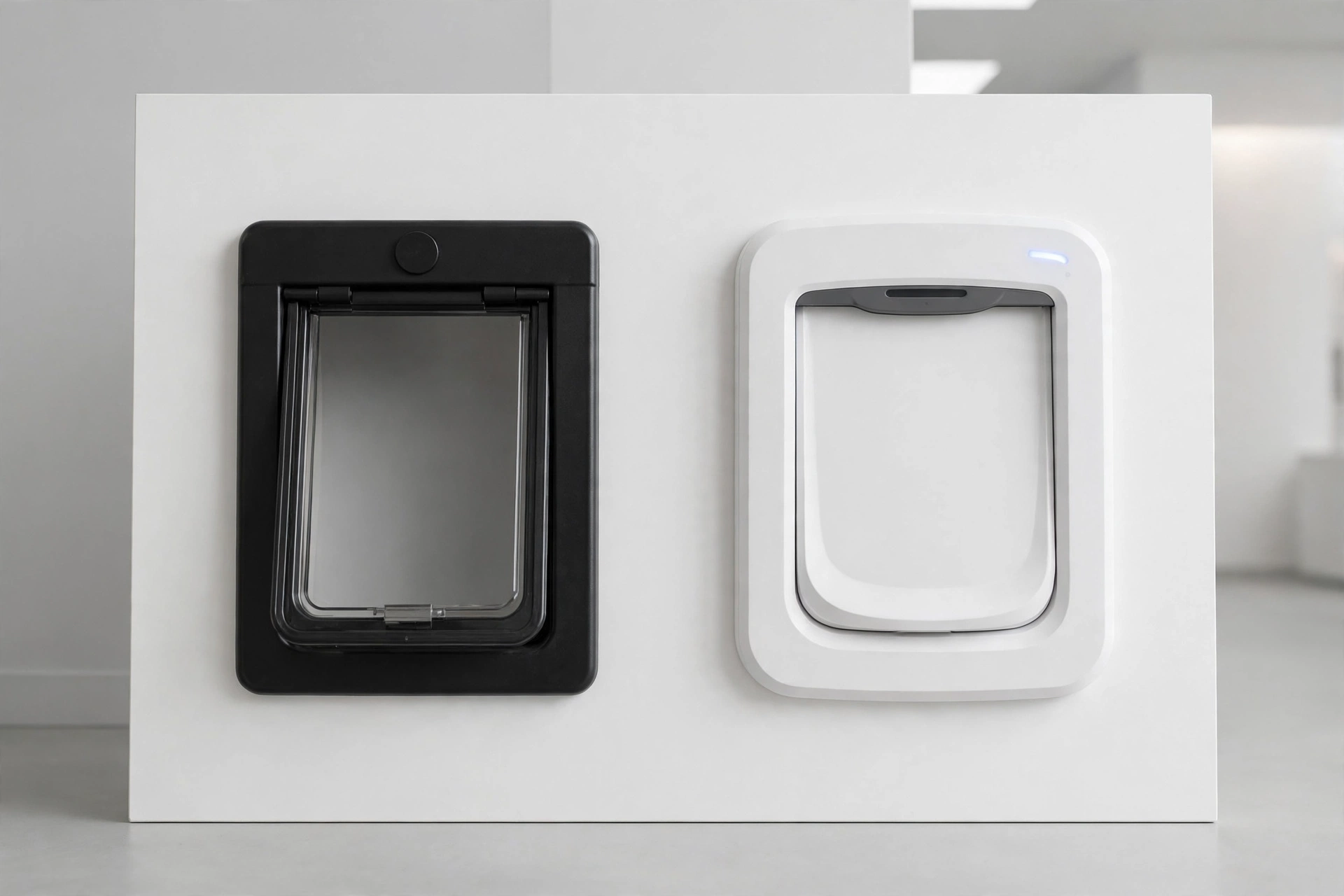
Compare the microchip cat flap models and the manual cat flap options to see both ranges side by side.
FAQ
Is a manual flap unsafe?
It is not unsafe, it is indiscriminate. It cannot tell your cat from any other animal. In a street with no roaming animals, that distinction does not matter.
Do microchip flaps need charging?
No. They run on four AA batteries. There is no cable and no charging routine.
Can I start with manual and switch to microchip later?
Usually yes. Ask your fitter before the first fitting, so the opening suits both. In many cases the same panel can take either flap.
Which one lasts longer?
Both are built for years of daily use. The manual has no electronics to age. The microchip has batteries to change and a reader to keep clean. Neither asks for much.
Next in this series: large cat flaps for big cats, the over-5-kg case.